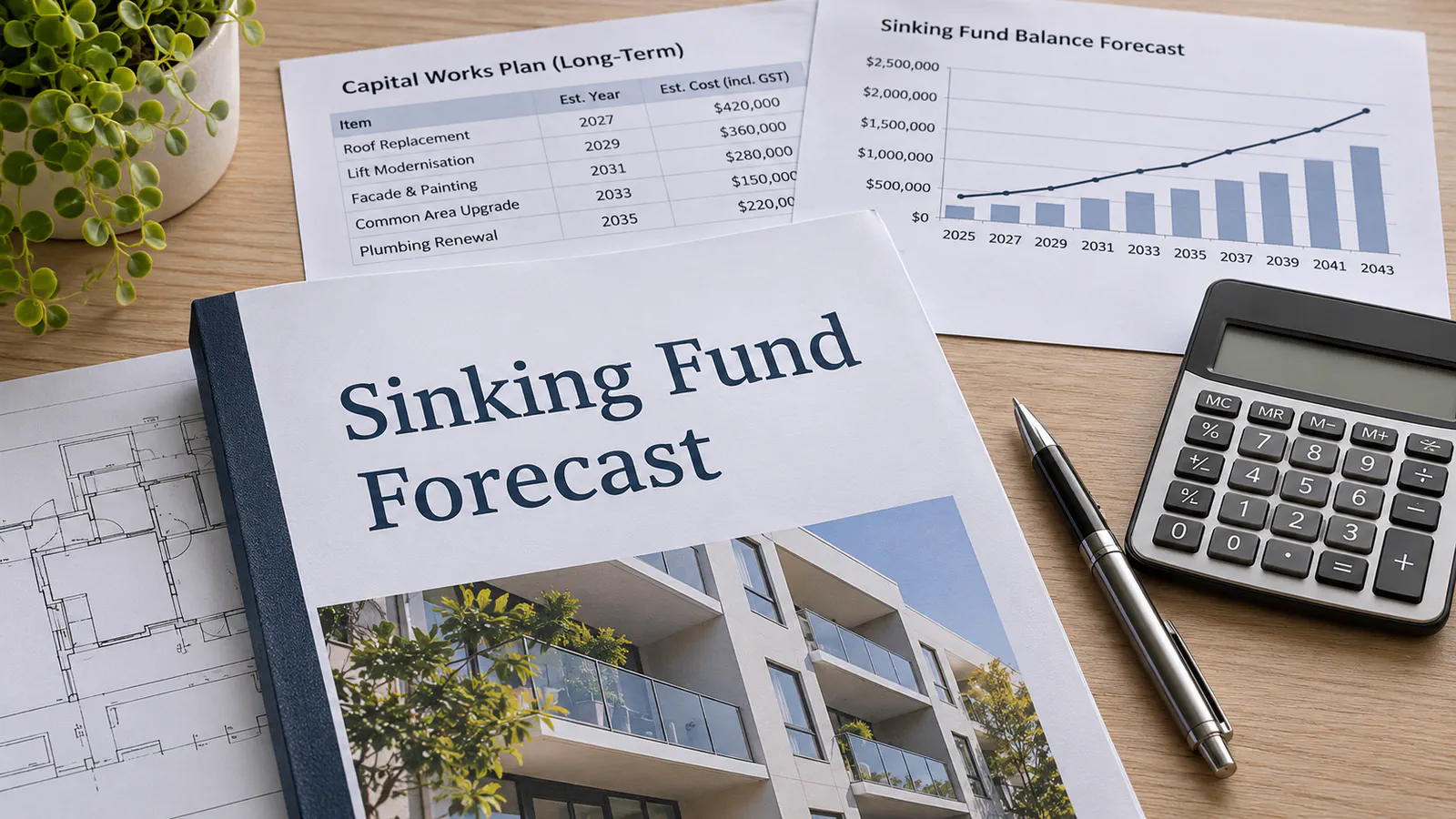
Managing a body’s corporate finances isn’t always straightforward, particularly when it comes to planning for major repairs, maintenance and future capital expenditure.
A sinking fund forecast plays an important role in ensuring sufficient funds are available when major works are required, without placing unnecessary financial pressure on owners.
However, getting the balance right is important. Both underfunding and overfunding can create problems for a body corporate.
The Good: Getting Your Sinking Fund Right
A well-prepared sinking fund forecast helps a body corporate plan for the long-term maintenance, repair and replacement of common property assets.
Depending on the scheme, these expenses may include:
- Building repainting and external maintenance.
- Roof repairs and replacements.
- Lift upgrades and modernisation.
- Waterproofing and major building repairs.
- Replacement of common property plant and equipment.
- Swimming pools, recreational facilities and landscaping.
By planning for these expenses, the body corporate can establish appropriate sinking fund contributions and reduce the likelihood of unexpected financial burdens on owners.
Good cost planning means knowing what needs to be done, when it is likely to be required and how much the body corporate should be putting aside.
The Bad: Underfunding Your Sinking Fund
One of the most common challenges facing bodies corporate is having insufficient funds available when major works become necessary.
When sinking fund contributions are set too low, the scheme may struggle to pay for significant repairs, replacements or maintenance projects.
This can lead to:
- Unexpected special levies imposed on owners.
- Delayed maintenance and capital works.
- Increased deterioration of common property assets.
- Financial hardship for owners.
- Disagreements between committee members and owners over expenditure.
For example, a building may require repainting, waterproofing or a major lift upgrade, only for the committee to discover that the sinking fund has insufficient money available.
The result can be substantial special levies or the postponement of necessary works.
What initially appeared to be affordable body corporate levies can become a significant financial burden later.
The Ugly: Overfunding and Poor Financial Planning
While having insufficient funds creates obvious problems, collecting more than necessary can also be a concern.
Overfunding may result in owners paying unnecessarily high contributions, with excess funds accumulating without a clear purpose or planned expenditure.
This can create frustration among owners who may question whether their levies are being managed appropriately.
However, a healthy sinking fund balance does not automatically mean a scheme is overfunded. Large capital works can require substantial reserves, particularly in high-rise buildings and complex developments.
The important consideration is whether the fund balance and proposed contributions are supported by a realistic assessment of future expenditure.
The objective isn’t simply to collect more or less money. It’s to collect the right amount at the right time.
The Importance of an Accurate Sinking Fund Forecast
A sinking fund forecast estimates the anticipated cost and timing of major capital expenditure, helping the body corporate plan appropriate contributions over the forecast period.
At Olive Tree Consulting Group, our quantity surveying team considers the property’s common property assets, anticipated replacement and maintenance requirements, available financial information and future capital works.
For larger or more complex schemes, particular attention may be required for major expenditure such as lift upgrades, building repainting, waterproofing, structural repairs and plant replacements.
Regular reviews are also important, particularly when:
- Major capital works have been completed.
- New building defects or maintenance requirements have been identified.
- Contractor quotations or construction costs have changed.
- Planned works have been brought forward or delayed.
- The body corporate is considering significant expenditure.
An outdated forecast may no longer reflect the property’s actual financial requirements.
The Problem with Low Body Corporate Levies in New Developments
Another important consideration is the financial planning undertaken before a new strata scheme is established.
Low advertised body corporate levies can make an off-the-plan development appear more attractive to prospective purchasers.
However, where initial sinking fund contributions are based on unrealistic assumptions or insufficient allowances for future capital expenditure, owners may face substantial increases in later years.
At Olive Tree Consulting Group, we have encountered schemes where initial contributions were insufficient to meet anticipated future expenditure.
This can leave newly established bodies corporate facing sharp levy increases as the true maintenance and replacement costs become apparent.
Accurate cost planning from the outset is essential to establishing realistic budgets and helping owners understand the ongoing financial commitments associated with their property.
Why Professional Cost Planning Matters
Every strata scheme is different.
A small townhouse development will have very different capital expenditure requirements from a high-rise residential tower, commercial development or large resort-style complex.
A professionally prepared sinking fund forecast should reflect the building’s actual assets, condition, anticipated expenditure and relevant financial requirements.
Engaging an experienced quantity surveyor can help committees:
- Understand upcoming capital works and their estimated costs.
- Establish appropriate sinking fund contributions.
- Plan for major maintenance and replacement projects.
- Reduce the risk of unexpected special levies.
- Make informed financial decisions for the long-term benefit of owners.
Ultimately, effective cost planning is about balancing the financial needs of the building with the contributions required from its owners.
Is Your Body Corporate’s Sinking Fund on Track?
Whether your scheme is newly established, approaching major capital works or experiencing unexpected levy increases, reviewing your sinking fund forecast can help identify potential funding concerns before they become more significant.
Olive Tree Consulting Group provides independent sinking fund forecasts and cost-planning advice for residential, commercial and mixed-use strata developments across Queensland and Northern NSW.
Our experienced quantity surveying team can assist with preparing new forecasts, reviewing existing forecasts and assessing upcoming capital expenditure.
Contact our team to discuss your sinking fund requirements or request an obligation-free quote.