Fire safety compliance is a significant responsibility for bodies corporate, particularly those managing residential apartment buildings, high-rise developments and resort-style complexes.
While many buildings have contractors regularly servicing their fire safety equipment, this does not necessarily mean that all legislative requirements are being met.
At Olive Tree Consulting Group, our experience conducting Fire Safety Audits and compliance assessments across Queensland has highlighted the importance of reviewing not only fire safety installations, but also evacuation procedures, documentation, training and ongoing record keeping.
A building may have its fire equipment regularly serviced while still having outstanding fire safety compliance requirements.
So, what should your body corporate be checking?
1. Are Your Fire and Evacuation Plans Current?
Under Queensland’s Building Fire Safety Regulation 2008, applicable buildings must have a written Fire and Evacuation Plan that outlines the procedures to be followed in the event of a fire or hazardous materials emergency.
For Class 2 residential apartment buildings, a common area Fire and Evacuation Plan is generally required for the building.
Section 28 of the Regulation requires the plan to be reviewed at intervals of no more than one year, with a written record of the review maintained.
However, simply having a plan on file does not mean that it remains current.
Plans should reflect the building’s current layout, emergency procedures, evacuation routes and relevant personnel.
Common issues include:
- Fire and Evacuation Plans that have not been reviewed annually.
- Outdated contact details or nominated responsible persons.
- Plans that do not reflect alterations to the building.
- Missing or incomplete evacuation procedures.
- Annual review records that cannot be produced.
A regular review helps ensure the building’s documentation remains accurate and appropriate for its current use.
2. Are Your Evacuation Signs and Diagrams Correct?
Evacuation diagrams are an important part of a building’s emergency preparedness.
Under Section 30 of the Building Fire Safety Regulation 2008, evacuation signs and diagrams must be appropriately located, clearly displayed and correctly orientated within applicable buildings.
The general display requirement under this section does not apply to buildings with a total floor area of less than 300 m², although other requirements may still apply.
During inspections, deficiencies may include:
- Missing or damaged evacuation diagrams.
- Incorrectly orientated diagrams.
- Outdated building layouts or evacuation routes.
- Missing assembly area information.
- Diagrams that have been removed during renovations or repainting.
- Signage that is poorly positioned or obscured.
These matters can affect a building’s compliance and the ability of occupants to identify appropriate evacuation routes during an emergency.
Olive Tree Consulting Group can assess existing evacuation diagrams and arrange updated documentation where required.
3. Has Your Annual Evacuation Practice Been Completed?
An annual evacuation practice is an important requirement that can sometimes be overlooked.
Under Section 44 of the Building Fire Safety Regulation 2008, applicable buildings must conduct an evacuation practice at intervals of no more than one year.
The practice must involve an appropriate number of people and be conducted in a manner that effectively tests the building’s evacuation arrangements.
A written record must also be maintained in accordance with Section 46.
An annual evacuation practice is more than simply sounding an alarm.
It provides an opportunity to assess whether evacuation procedures are understood, occupants can safely follow designated routes and any practical difficulties need to be addressed.
For residential apartment buildings, this does not necessarily require every resident to participate.
However, the exercise should be appropriately organised and documented.
At Olive Tree Consulting Group, we conduct evacuation practices for bodies corporate, helping ensure the necessary activities are undertaken and appropriate records are maintained.
4. Are Your Fire Safety Installations Being Properly Maintained?
Most bodies corporate engage specialist contractors to inspect, test and maintain their prescribed fire safety installations.
Depending on the building, these systems may include:
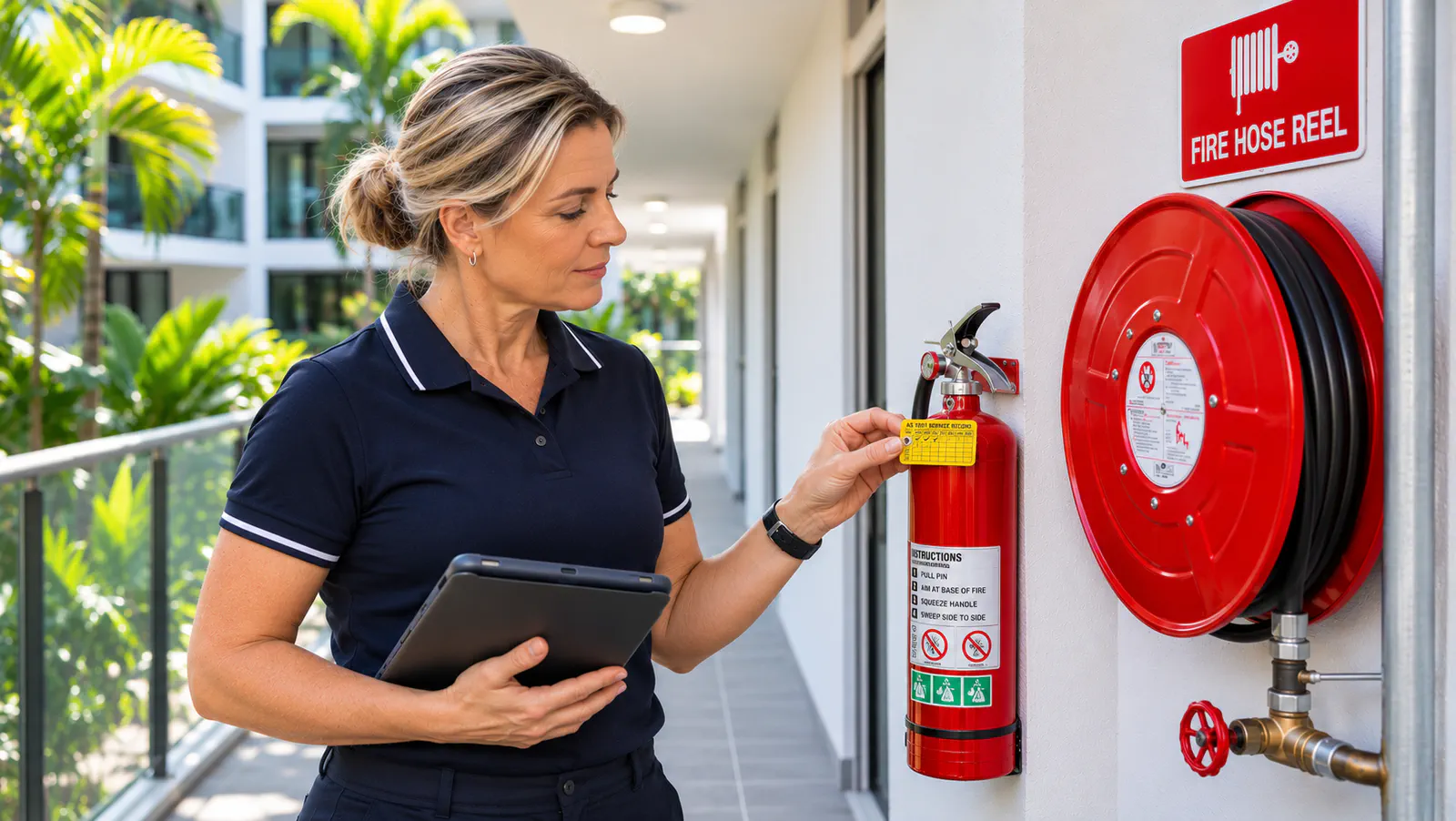
- Fire extinguishers and fire hose reels.
- Fire hydrants and sprinkler systems.
- Fire detection and alarm systems.
- Emergency lighting and illuminated exit signs.
- Fire and smoke doors.
- Mechanical smoke management systems.
- Other prescribed fire safety installations.
These installations must be maintained in accordance with applicable legislative requirements, including Queensland Development Code Mandatory Part 6.1 and relevant Australian Standards.
However, equipment servicing and an independent Fire Safety Audit serve different purposes.
Fire equipment servicing focuses on maintaining specific installations, while a Fire Safety Audit assesses broader compliance arrangements and potential deficiencies.
An independent audit can review whether servicing records are available, relevant installations appear appropriately maintained and outstanding issues have been identified.
It can also identify visible safety concerns such as obstructed evacuation routes, damaged fire doors, inappropriate storage and deficiencies in evacuation signage.
5. Has Your Annual Occupier’s Statement Been Lodged?
An Occupier’s Statement is another important document that bodies corporate should ensure is completed where required.
Under Section 55A of the Building Fire Safety Regulation 2008, building occupiers must prepare an Occupier’s Statement relating to prescribed fire safety installations in accordance with Queensland Development Code MP 6.1.
The statement must be retained with the relevant maintenance records and submitted to the Queensland Fire Department within the prescribed timeframe.
A common misconception is that the annual statement is automatically submitted by the building’s fire maintenance contractor.
Bodies corporate should confirm who is responsible for preparing and lodging the statement, rather than assuming it has been completed.
At Olive Tree Consulting Group, we assist bodies corporate with the preparation and lodgement of annual Occupier’s Statements.
6. Have Appropriate Fire and Evacuation Instructions Been Provided?
Fire safety compliance also involves ensuring that relevant people understand their responsibilities during an emergency.
Depending on the building and the persons involved, requirements under the Building Fire Safety Regulation 2008 include general evacuation instructions, first-response evacuation instructions and evacuation coordination instructions.
For example, individuals with responsibility for coordinating an evacuation must receive appropriate instructions at the required intervals.
Providing instructions helps ensure that relevant personnel understand the building’s evacuation arrangements, emergency procedures and the actions expected of them.
Olive Tree Consulting Group provides fire safety training and instruction services tailored to the requirements of bodies corporate and their buildings.
7. When Was Your Last Independent Fire Safety Audit?
Although an independent Fire Safety Audit is not universally mandatory for Class 2 residential buildings, the body corporate remains responsible for meeting its applicable fire safety obligations.
A comprehensive audit can help committees and strata managers establish whether their building’s fire safety arrangements are being adequately managed.
This is particularly valuable where:
- The building has not undergone an independent compliance review for several years.
- Fire safety documentation or servicing records are incomplete.
- There have been changes to building management or contractors.
- Evacuation plans and diagrams may be outdated.
- Previous compliance deficiencies remain unresolved.
- The committee is uncertain whether all legislative requirements have been addressed.
An independent audit provides a structured assessment of the building’s fire safety arrangements, helping identify deficiencies and establish appropriate corrective actions.
For bodies corporate, this can assist with maintaining compliance, improving record keeping and making informed decisions about outstanding works.
Fire Safety Compliance Is More Than Equipment Servicing
A common mistake is assuming that regular attendance by a fire maintenance contractor means the building has satisfied all its fire safety obligations.
While equipment maintenance is essential, fire safety compliance also involves evacuation planning, training, annual practices, documentation and record keeping.
These responsibilities can involve multiple contractors, building managers and strata management personnel.
Without appropriate oversight, important requirements may be overlooked.
An independent review can help identify these gaps and provide committees with a clearer understanding of their building’s compliance position.
How Olive Tree Consulting Group Can Help
At Olive Tree Consulting Group, our qualified Fire Safety Advisers (FSAs) specialise in providing independent fire safety compliance services for bodies corporate, residential apartment buildings, commercial properties and resort-style developments throughout Queensland.
Our services include:
Fire Safety Audits
Comprehensive assessments of relevant fire safety measures, evacuation arrangements, maintenance records and building conditions to identify compliance deficiencies and associated risks.
Fire Safety Training
Fire safety instruction and training for relevant occupants, residents and personnel, tailored to the building’s requirements.
Annual Evacuation Practices
Organisation and conduct of evacuation practices, including appropriate documentation and records.
Occupier’s Statements
Preparation and lodgement of annual Occupier’s Statements on behalf of bodies corporate, based on the required fire safety maintenance documentation.
Our assessments are independent, with clear reporting designed to help body corporate committees and strata managers understand their obligations and identify matters requiring attention.
Is Your Body Corporate’s Fire Safety Compliance Up to Date?
Whether your building requires an independent Fire Safety Audit, annual evacuation practice, fire safety training or an Occupier’s Statement, Olive Tree Consulting Group can assist.
We work with bodies corporate and strata managers throughout the Gold Coast, Brisbane, Sunshine Coast, Toowoomba and surrounding Queensland regions.
Or contact our team on 1300 142 172 to discuss your building’s requirements.
References
- Building Fire Safety Regulation 2008 – Queensland Legislation
- Queensland Fire Department – Fire Safety Management Tool and Advisory Notes
- Body Corporate Fire Safety Duties
This article provides general information. Fire safety requirements depend on a building’s classification, configuration and applicable legislation.